In the second paragraph of the foreword to the first published volume of the deluxe twelve volume set of reprints from the Don Lawrence Collection, the editor has this to say—
By this point in the history of the story, scriptwriter Mike Butterworth had moved away from his original influences – the Trigan Empire was clearly originally inspired by the Roman Empire and the title reflected Edward Gibbon’s monumental The History of the Decline and Fall of the Roman Empire – and was answering the editorial brief for shorter, more adventurous stories following the lengthy, 23 episode, story arc concerning ‘The Five Labours of Trigo’ in 1970. The stories over the next few years lasted an average 9 episodes . . .
Let’s unpack this.
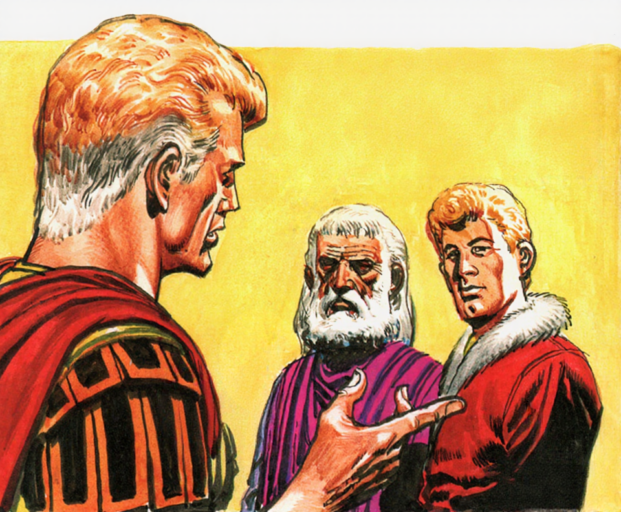
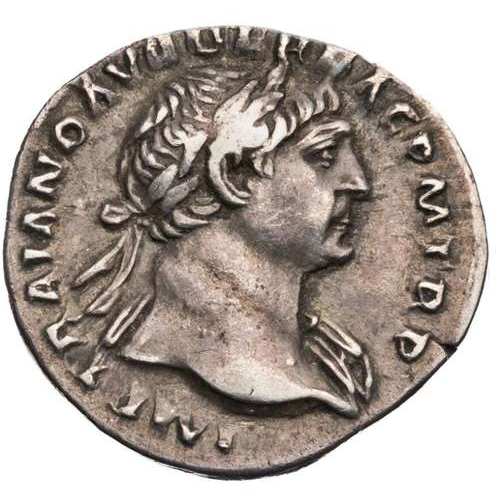
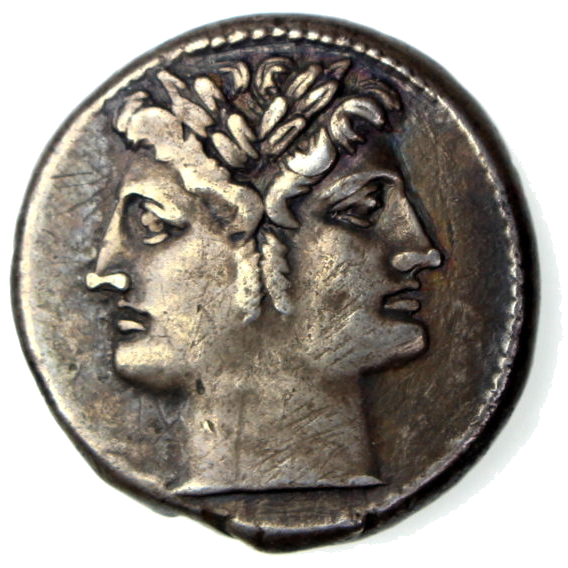
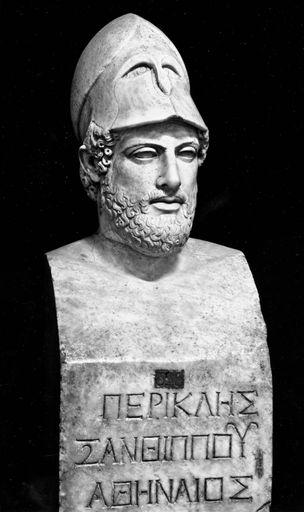
Certainly, the Trigan Empire was originally inspired by the Roman Empire, and by ancient Rome and classical antiquity more generally. Take, for example, the names of the three main characters of the series. The name Trigo (and the Trigan Empire) are more than likely derived from that of the Roman Emperor Trajan. Janno is probably named after the Roman god Janus. And Peric almost certainly is named after the preeminent Greek statesman Pericles.
And The History of the Decline and Fall of the Roman Empire is indeed monumental! Gibbons devoted the best part of his life to it. Published in six volumes between 1776 and 1789, it contains 71 chapters spanning well over 3000 pages. And it only covers the decline and fall of the Roman Empire—not its rise. (And not the history of the Roman Kingdom or Roman Republic either.)
Augustus (also known as Octavian) was the founder of the Roman Empire and the first Roman emperor from 27 BC until his death in AD 14. After his passing, there followed a succession of approximately 70 Roman Emperors. About as many Roman Emperors as there are Trigan Empire episodes penned by Mike Butterworth, in fact. And yet, even after so many episodes, Trigo, the first Emperor of Trigan, remains on the throne—as readers of the original series were regularly reminded at the start of each new episode . . .
The planet Elekton lies in the galaxy of Yarna, and the greatest power on Elekton is the Trigan Empire, ruled over by its founder, the Emperor Trigo.
It seems clear that, at its conception, The Rise and Fall of the Trigan Empire was intended to be similarly epic—recounting the rise and fall of successive Trigan emperors—charting the course of a veritable dynasty. But then—as noted above by the editor of the Don Lawrence Collection—it happened! Mike Butterworth moved away from his original influences. The Trigan Empire peaked—and plateaued.
Just to be clear, Butterworth “moved away from his original influences” after Episode 15—from 1969 onwards. Whereas the “editorial brief for shorter, more adventurous stories” came somewhat later, circa Episode 25—from 1971 onwards. (The volume in question, titled The Prisoner of Zerss, reprinted for the first time Episodes 29, 30, 31 & 33, tales originally published in 1971 and 1972.)
What follows is a survey of the rise of the Trigan Empire, arranged in several sections.
Three years
Three brothers
Three nieblings
Three women
Three princes
Three kings
Three reboots
Three parallels
Three years
Mike Butterworth was scriptwriter for a bit over 12 years, from late 1965 to the end of 1977. But the rise of the Trigan Empire happened in the space of the first three years—the first 14 episodes. Thereafter, further dynastic development is arrested.
Trigo reveals his ambitions in Ranger issue #2 (instalment 2 of Episode 1) published 25 September 1965—and Nikko becomes King of Hericon in Look and Learn issue #344 (instalment 13 of Episode 14) published 17 August 1968—a span of three years.
During these first 14 episodes we are introduced to all the main recurring characters—most of whom are not-so-main and not-so-recurring.
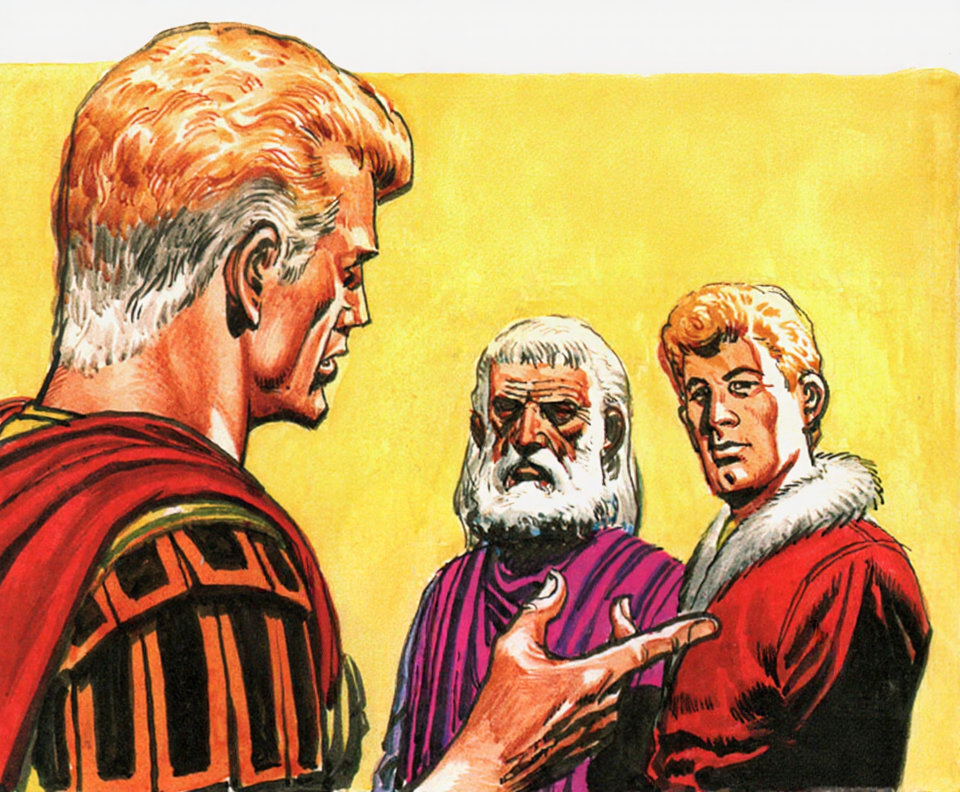
For those unfamiliar with the series—the Emperor Trigo, his nephew Janno, and Peric the wise old scientist from Tharv are, indubitably and indomitably, the three main characters. (See above).
There are three other oft-recurring characters—Janno’s comrades Keren and Roffa, and Janno’s father, Brag, the Emperor’s brother. Peric’s daughter, Salvia, shows up from time to time, too. (Not often enough.)
Three brothers
In the beginning, Trigo and his brothers Brag and Klud lead a nomadic tribe in the country of Vorg on the continent of Victris.
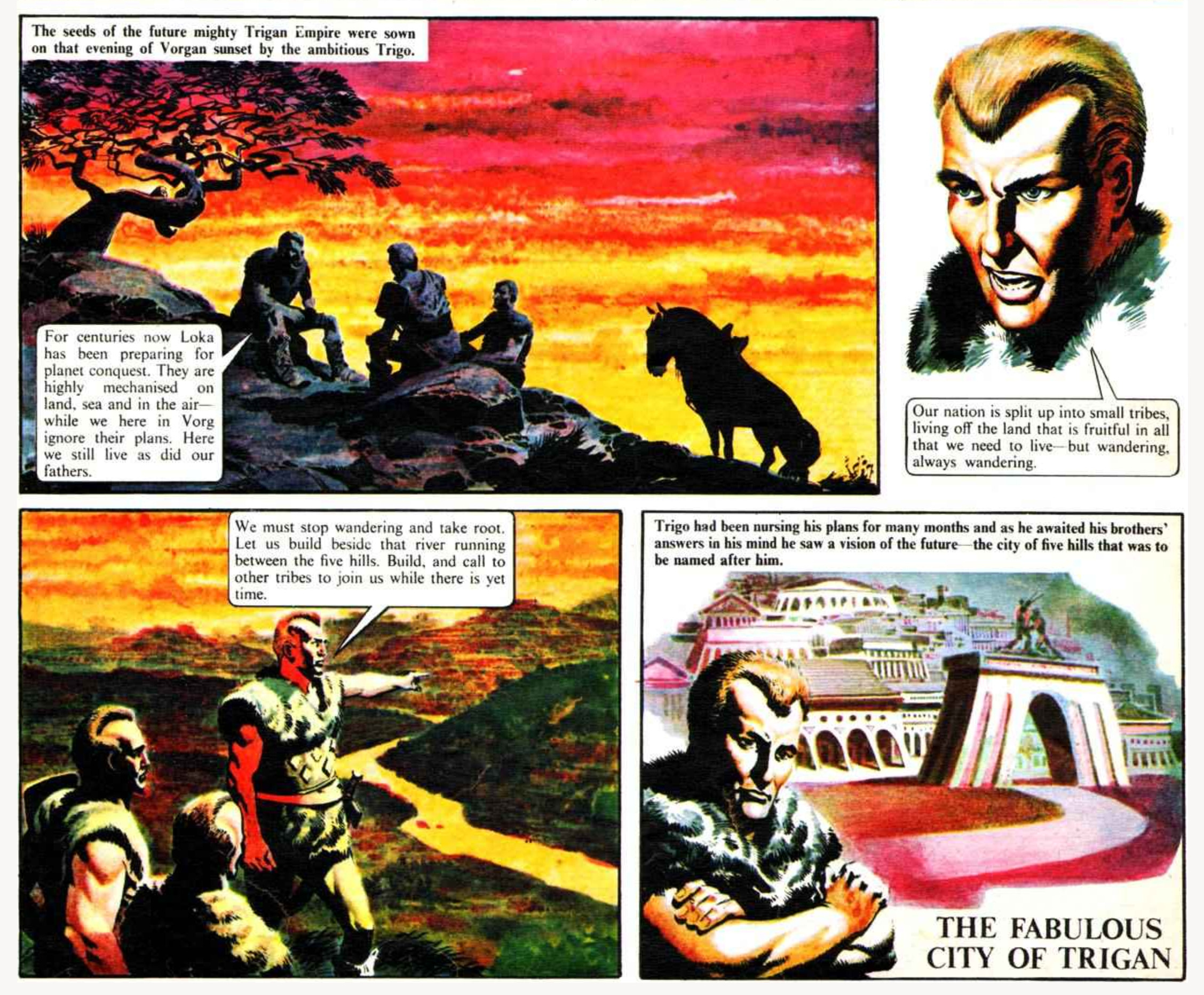
In Episode 1, Victory for the Trigans, Trigo unites the tribes of Vorg and defeats the Lokans. The city is built.
Klud is a main character, but a non-recurring one. He is killed in Episode 1 after betraying Trigo to the Lokans. We hear of him again only once. In Episode 29, The Masked Raiders, Klud reappears in a flashback scene.
Three nieblings
Trigo has two nephews (the sons of his brother Brag) and a niece (the daughter of his brother Klud).
In Episode 1, one of Brag’s sons is killed in an attack by the Lokans. This helps to persuade Brag to support Trigo in his plans.
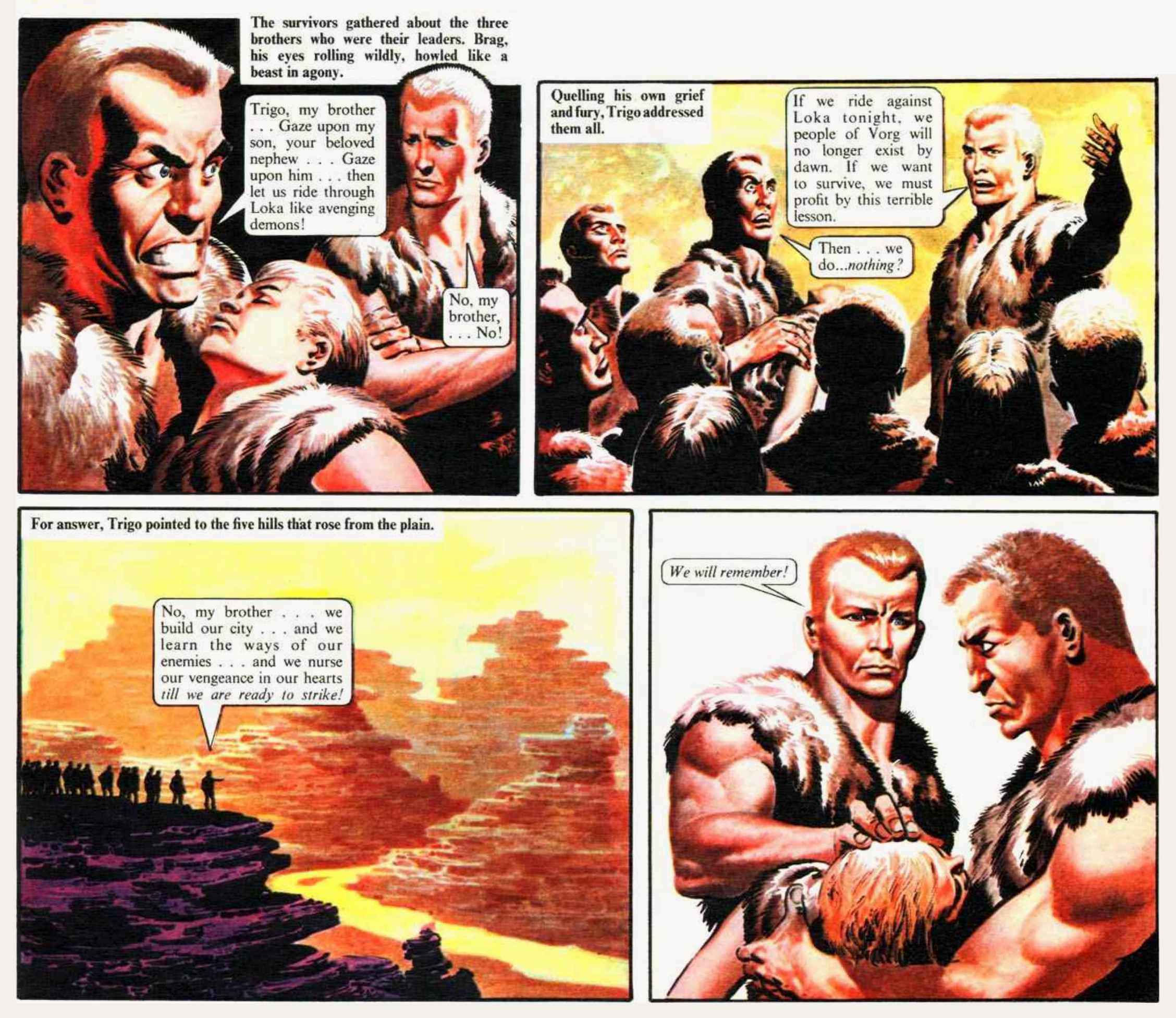
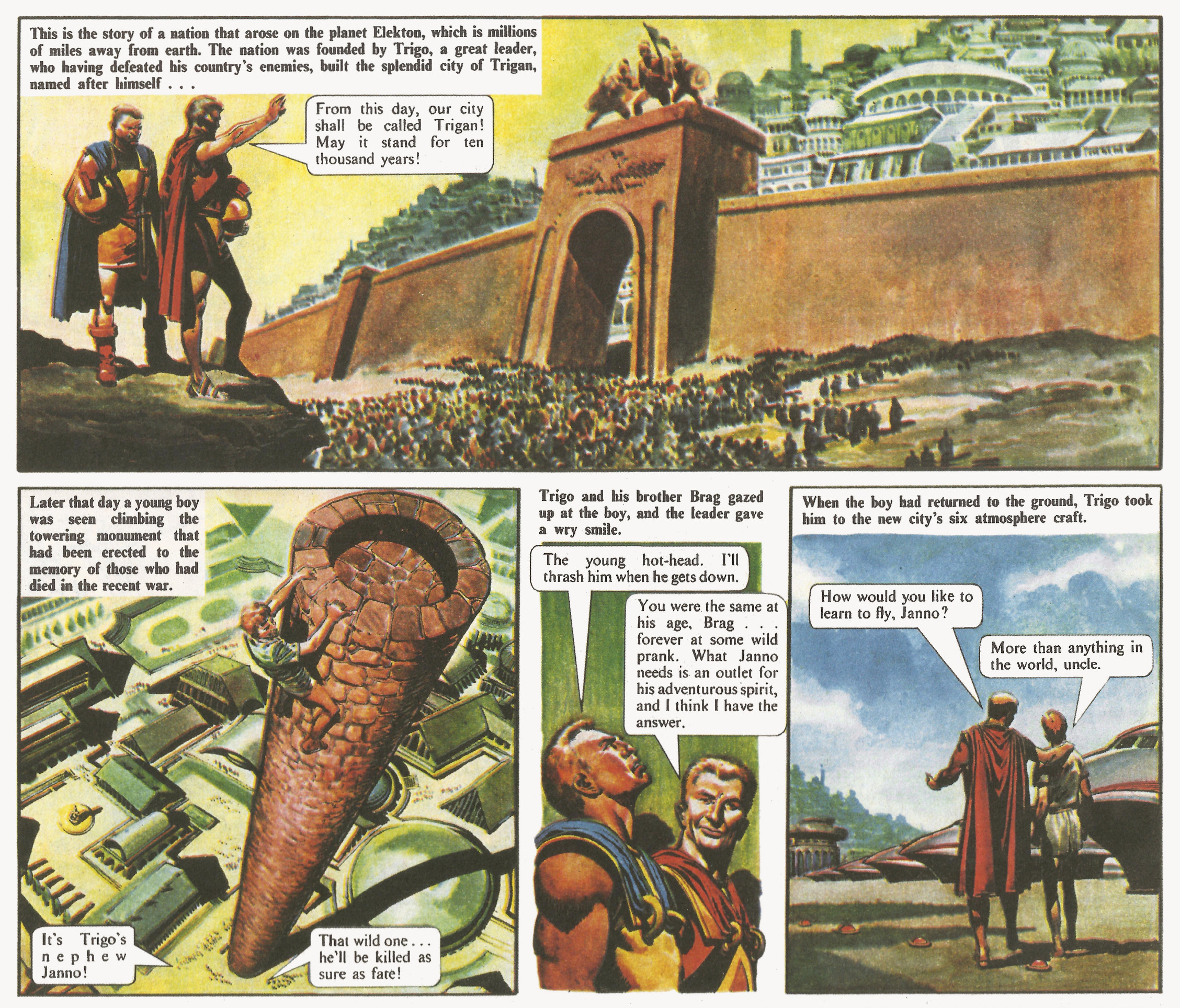
Although not named in Episode 1, according to tradition the dead son’s name is Zonna. Brag’s other son is Janno, who is introduced in Episode 2, Crash in the Jungle.
These are the opening panels of Episode 2. Trigo has founded a nation and built a city—both of which he names after himself.
‘Niebling’—a variant spelling of a word allegedly coined by Samuel E. Martin, a professor at Yale University, in 1951—rhymes with the German ‘liebling’, a word meaning “darling”. But Trigo’s niece Thara is no darling . . .
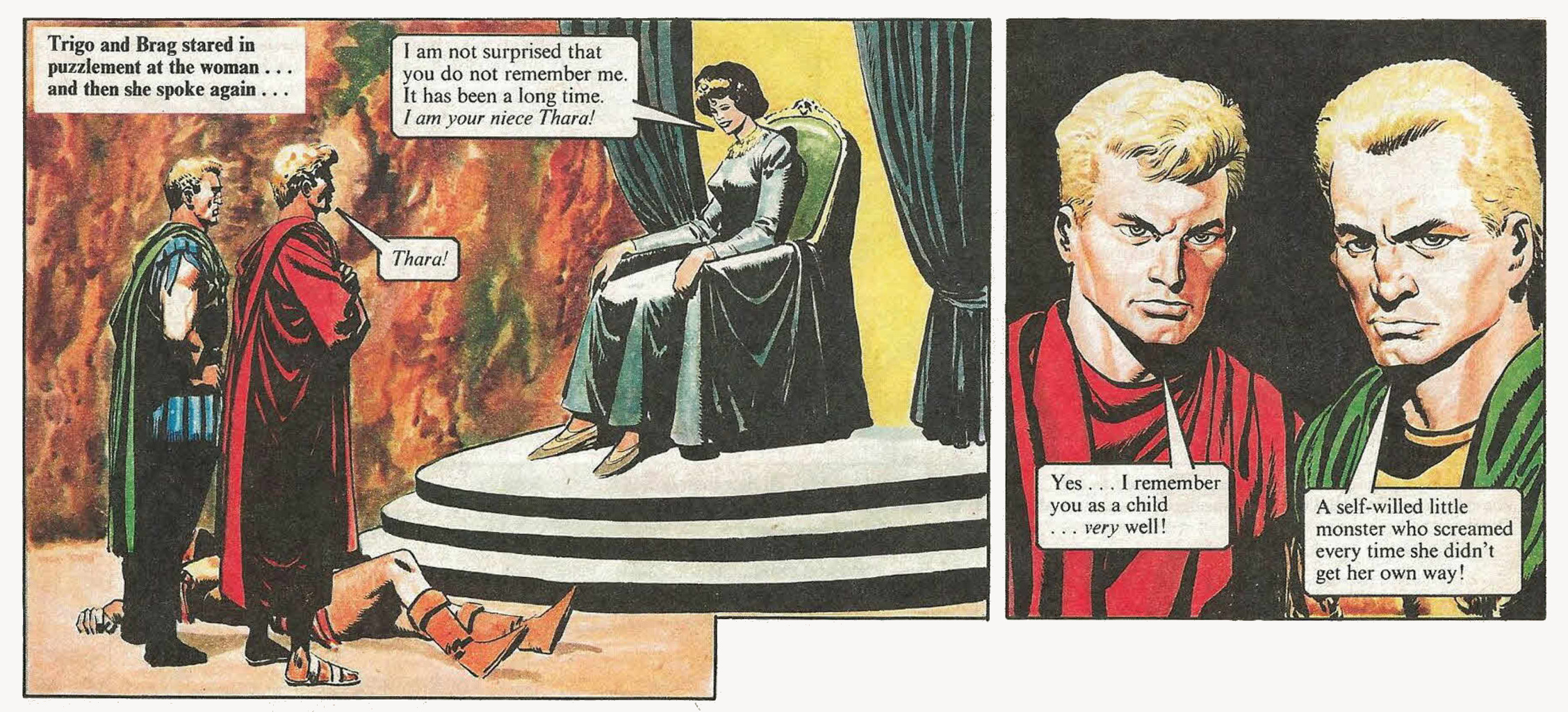
Thara first appears in Episode 12, The Reign of Thara, where she is the central character. She conspires to usurp the throne, and becomes Empress of Trigan. At the end of Episode 12, she is pardoned by Trigo for her treachery, and we never hear of her again.
Three women
The Trigan Empire has few female characters. One is the aforementioned Thara, niece of the Emperor Trigo.
Another is Salvia, Peric’s daughter, a physician. Salvia appears more often than any other female character. She features in Episodes 1, 2, 6, 12, 14, 29, and 30 (and in the apocryphal tale The Wise Man of Vorg).
Salvia barely qualifies as a main recurring character. Ursa certainly doesn’t. Ursa is Trigo’s wife. We first encounter her in Episode 7, War with Hericon.
This is the first page of Episode 7. Trigo’s nation—the nation of Trigan—is referred to as the Trigan Empire, although Trigo has not yet been formally crowned the first Emperor of Trigan.
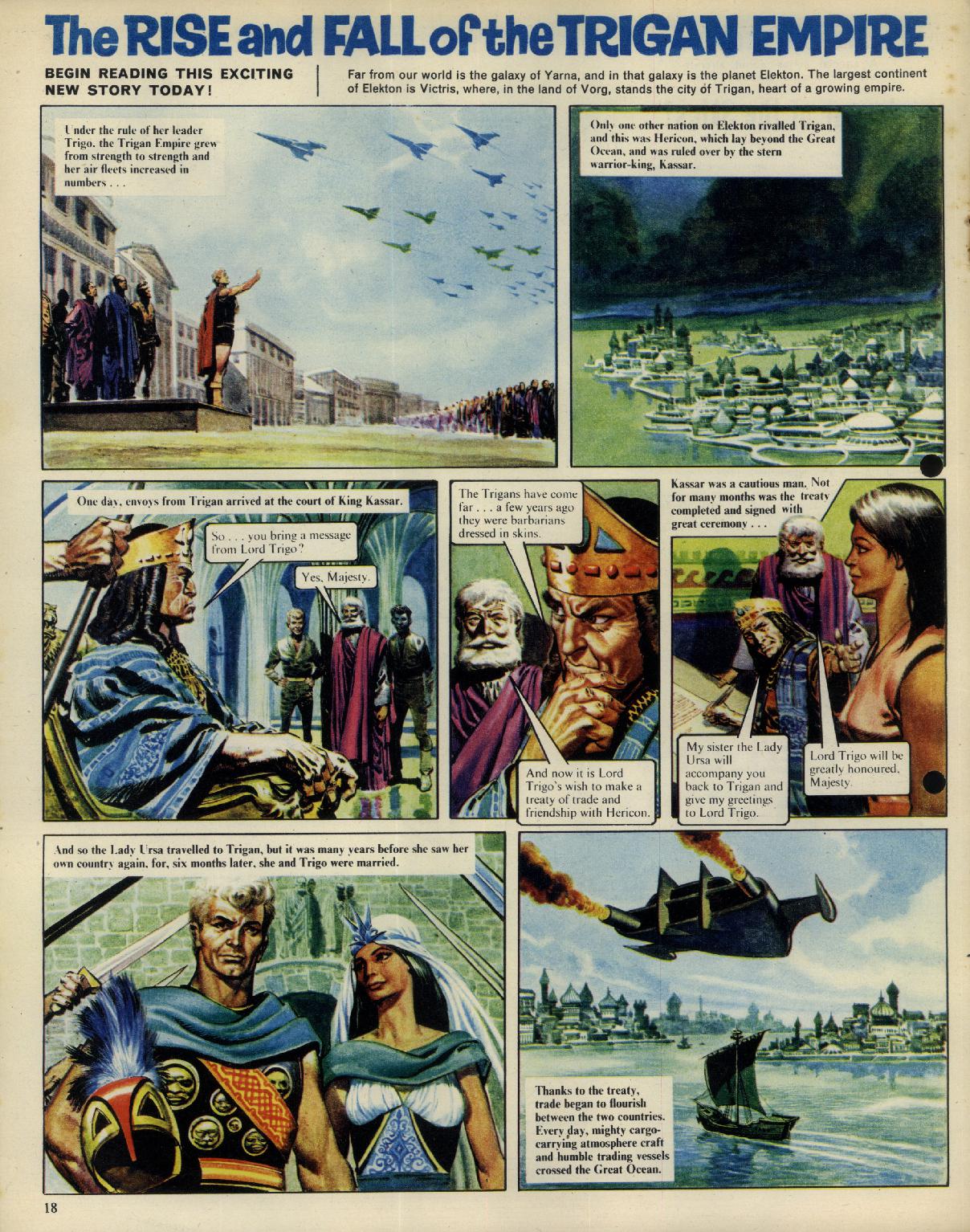
We learn of the existence of Hericon, and are introduced to its ruler, King Kassar, and his sister, Lady Ursa, who marries Trigo. A single panel is devoted to their wedding.
Ursa is in the first panel of the following episode, Episode 8. This is her last appearance until her final appearances in two or three panels in Episode 17, The Volcano Factory, where she accompanies Trigo on an ill-fated holiday.
These panels are the opening of Episode 8, Revolution in Zabriz. Note that here Janno is named as second in line of succession to the throne. Note also that Trigo’s coronation is incidental to the rest of the story.
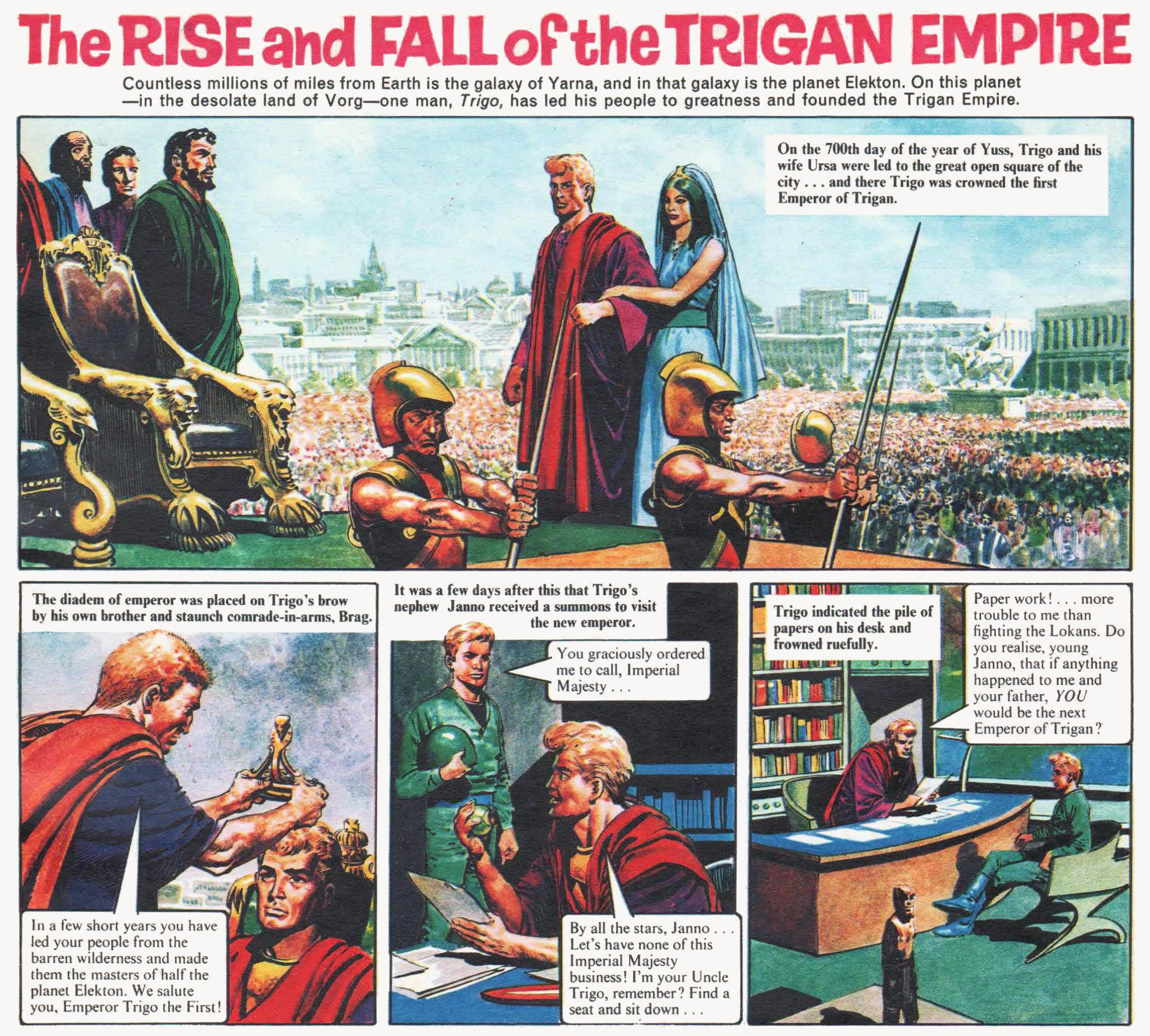
With the commencement of Episode 9, The Phials of Forgetfulness, mention of the rise and fall of the empire is dropped from the title banner. The series is now simply called The Trigan Empire. It’s still on the rise for a while yet, however.
Three princes
Bizarrely, Trigo’s wife Ursa is entirely absent from Episode 14, The Three Princes. Trigo’s triplet sons—Argo, Rilla, and Nikko—are hers too, after all. Perhaps her absence has to do with the fact that Trigo wants two of the three disposed of. Peric’s daughter Salvia is tasked with taking two of the newborns to be abandoned to their fate in the wilderness of Vorg.
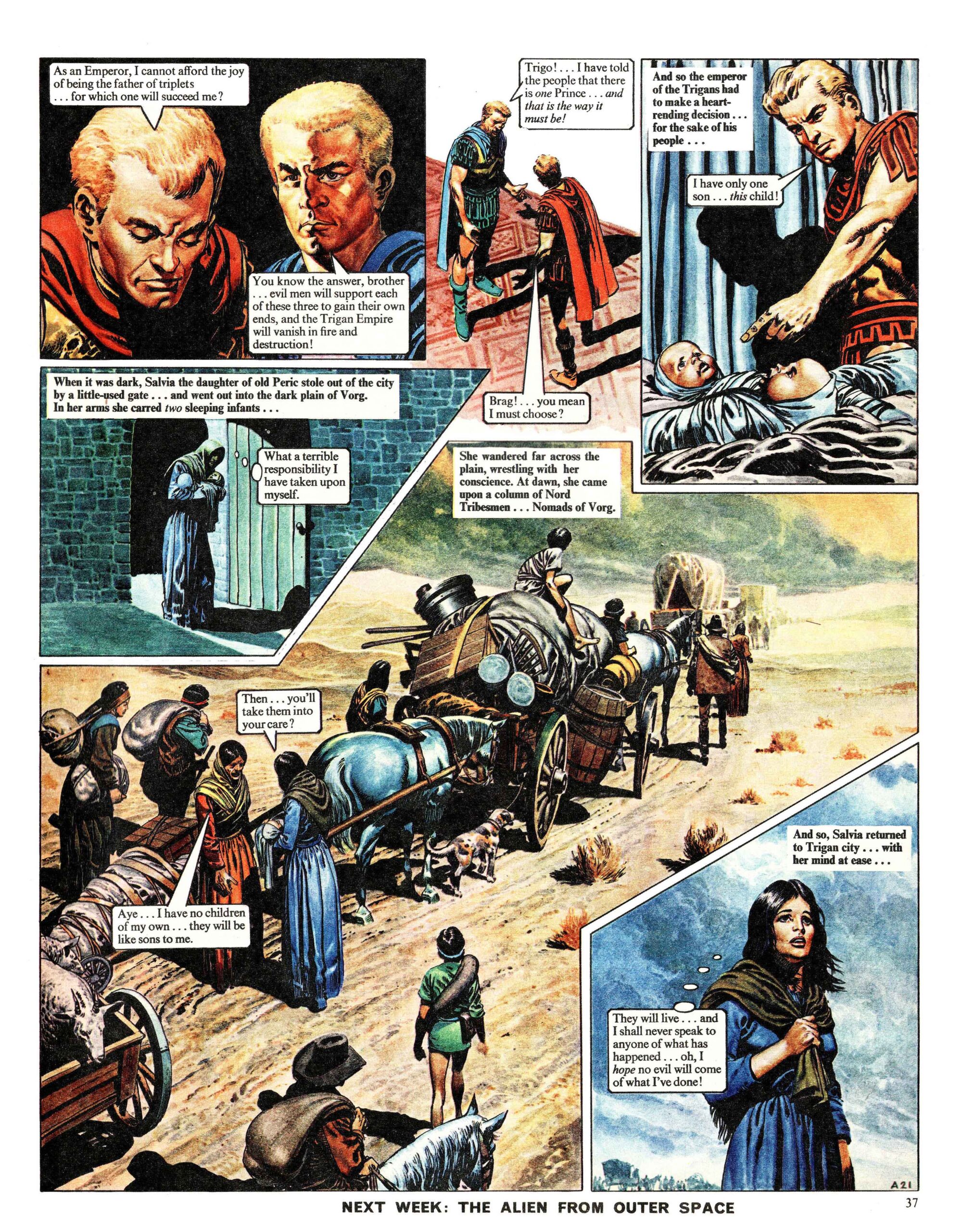
Quite a lot happens after that. Trigo’s chosen heir, named Argo, falls under the thrall of an evil alien being called Thringa. He causes Trigo’s atmosphere craft to crash in the jungle of Daveli. Argo, the pilot, ejects to safety. Subsequently, Argo crowns himself Emperor of Trigan.
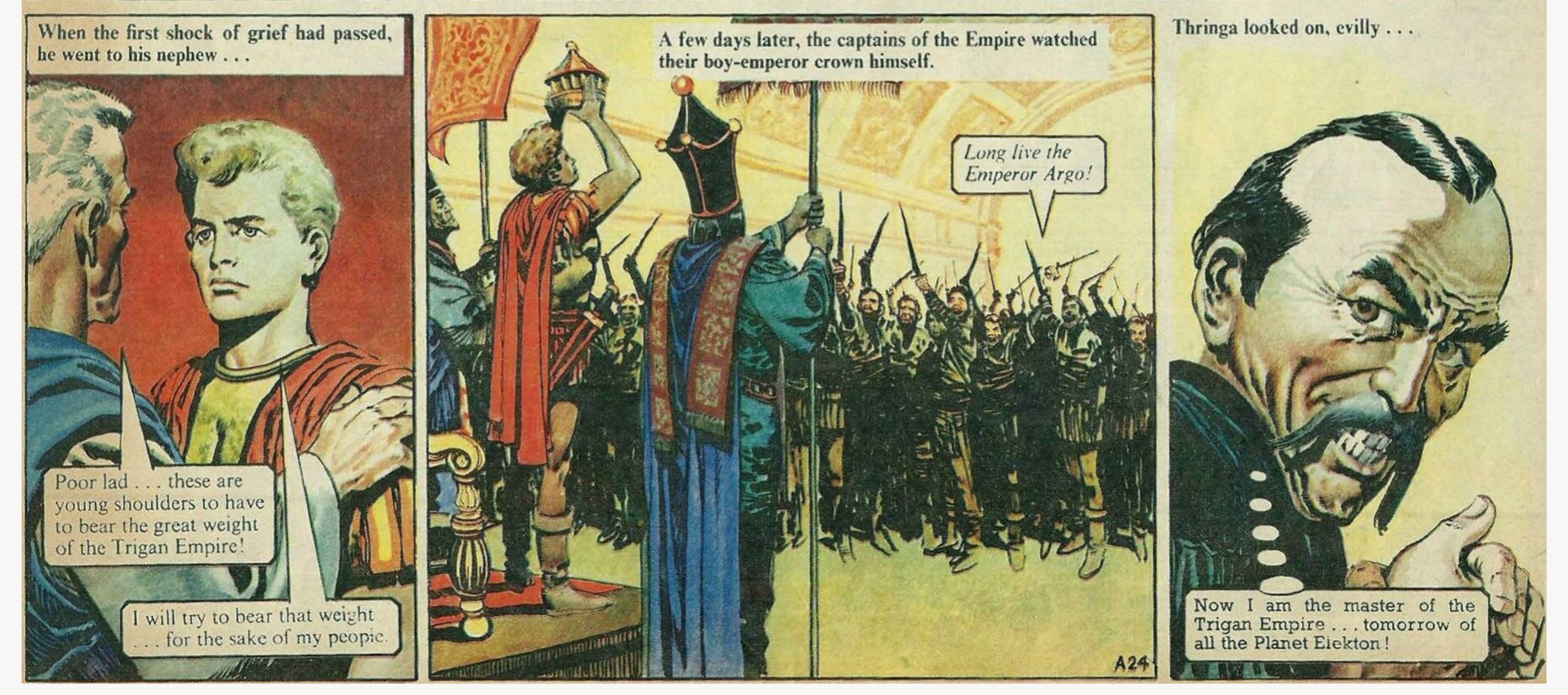
To cut a very long story short, Janno et al discover that Argo is controlled by Thringa, and plot to regain control of the empire. Salvia meets Argo’s twin brothers, Nikko and Rilla, in the market. The conspirators succeed in replacing Argo with Rilla, but during a speech, Rilla is killed, inciting a revolt against the regime. Argo is killed in an air battle. The surviving triplet Nikko becomes emperor-in-waiting. And then . . . Trigo returns from the dead.
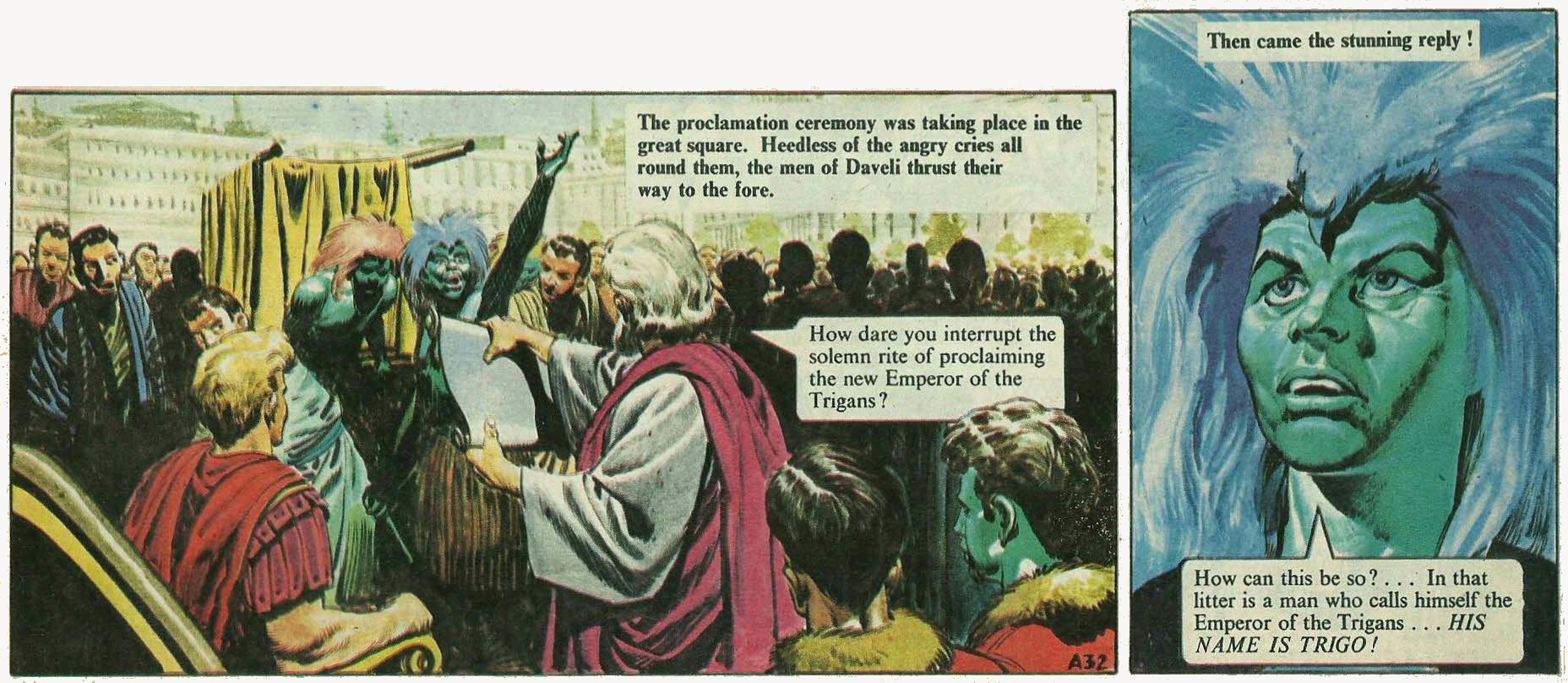
Shortly thereafter, as previously mentioned, Nikko is appointed King of Hericon. Nikko is the main character in the next episode, Episode 15, set in Hericon. Like his unfortunate brother Argo, Nikko too falls under an evil influence, this time from a contaminated beverage called gorbal.
Here are the final panels of Episode 15, Poison from Outer Space.
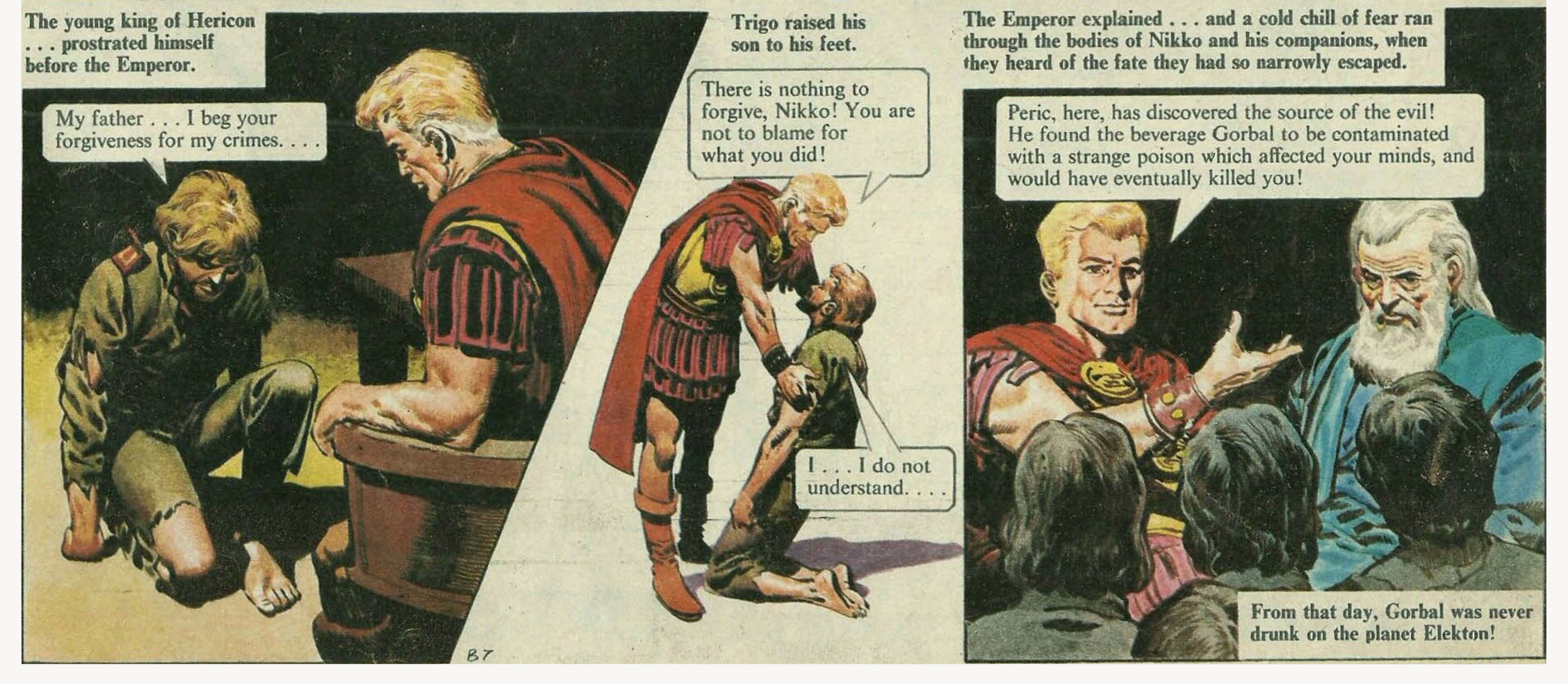
From that day, gorbal was never drunk on the planet Elekton . . . and also from that day, Nikko is never mentioned by name again! He gets mentioned as the King of Hericon once in Episode 22, The Puppet Emperor. And is alluded to once in Episode 28, The Duplication Machine.
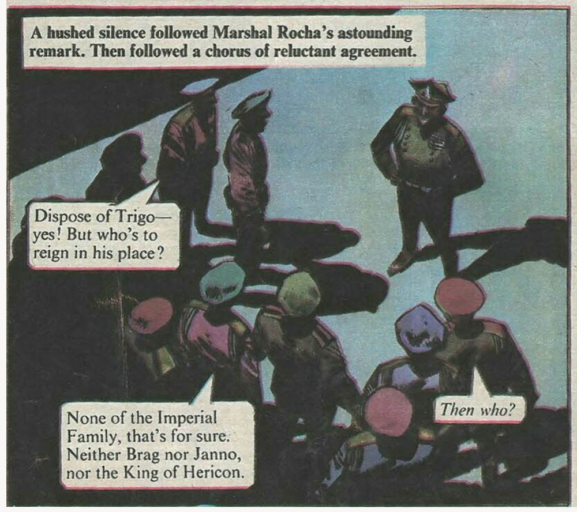
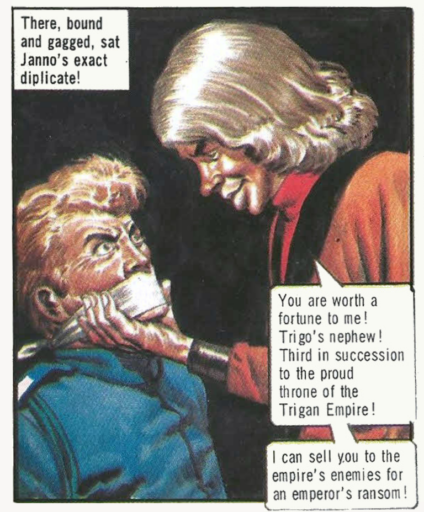
Thereafter, Hericon barely rates a mention, either. It’s mentioned in Episode 16, The Lost City. Janno is on leave from Hericon, and joins Trigo and his party of explorers, who depart on a secret mission on the pretext of visiting the Kingdom of Hericon.
And it’s also mentioned a couple of times in Episode 22, when loyalists in the Air Fleet mutiny against Marshal Rocha and the puppet Emperor Trigo II.
Lastly, in Episode 33, The Wish-Fulfiller, one member of the Imperial Council looks to be wearing a distinctive Hericon hat.
Three kings
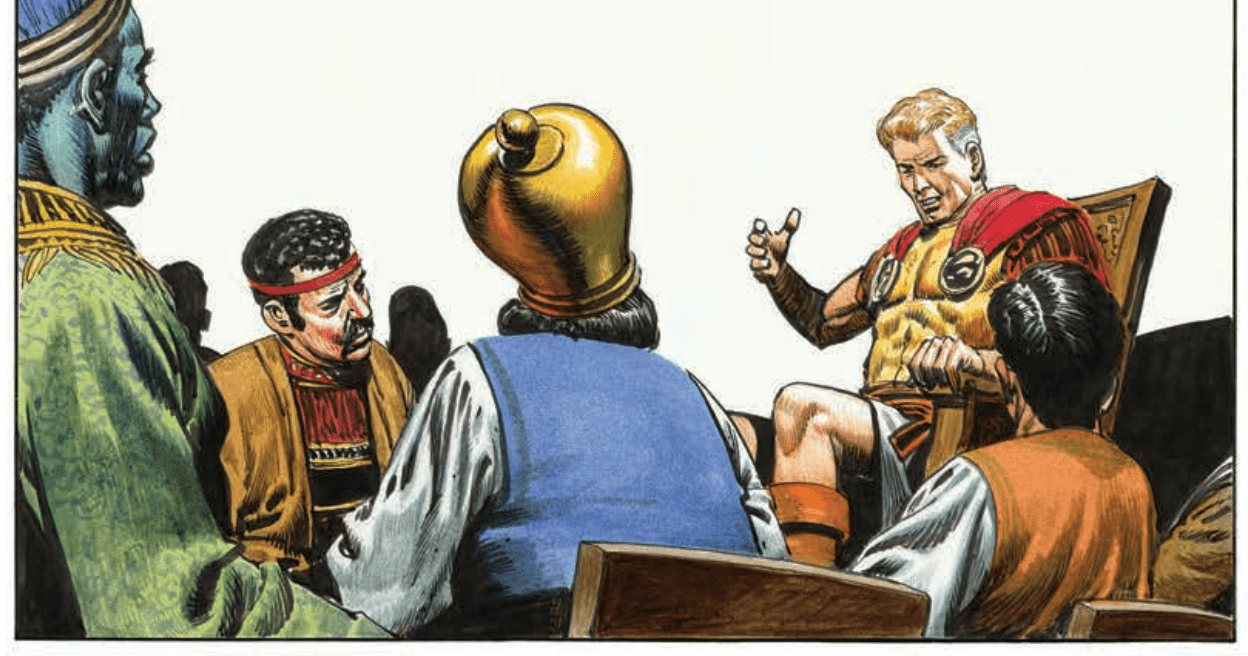
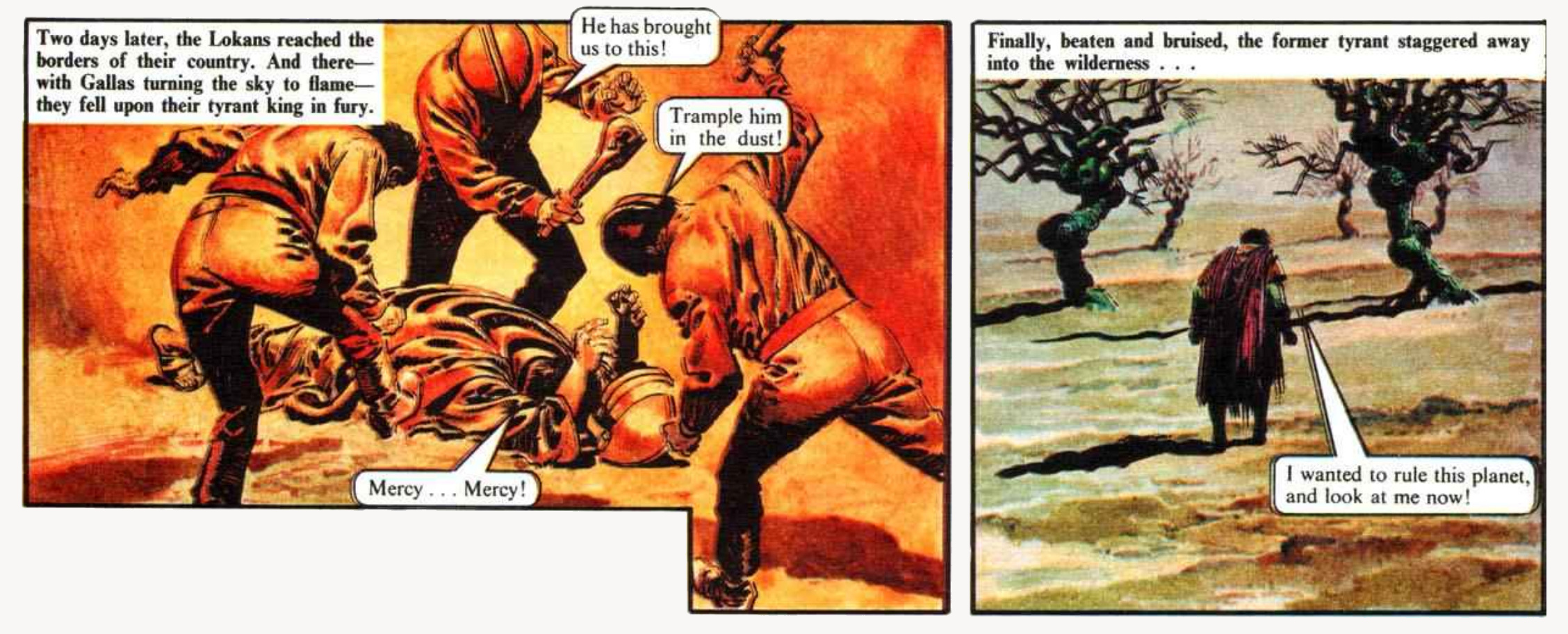
Notwithstanding Wikipedia’s entry on The Trigan Empire, King Zorth of Loka is not a main character—except in Episodes 1 and 3 only. Thereafter, he is only mentioned a couple of times. Once in the apocryphal tale The Wise Man of Vorg. And once in passing in Episode 45, The Great Flood. By the time of Episode 45, Loka is led by Yorri-Zim, a son of the tyrant Zorth—referred to as the last king of the Lokans. We must presume Zorth is deceased. He certainly wasn’t in great shape at the end of Episode 3!
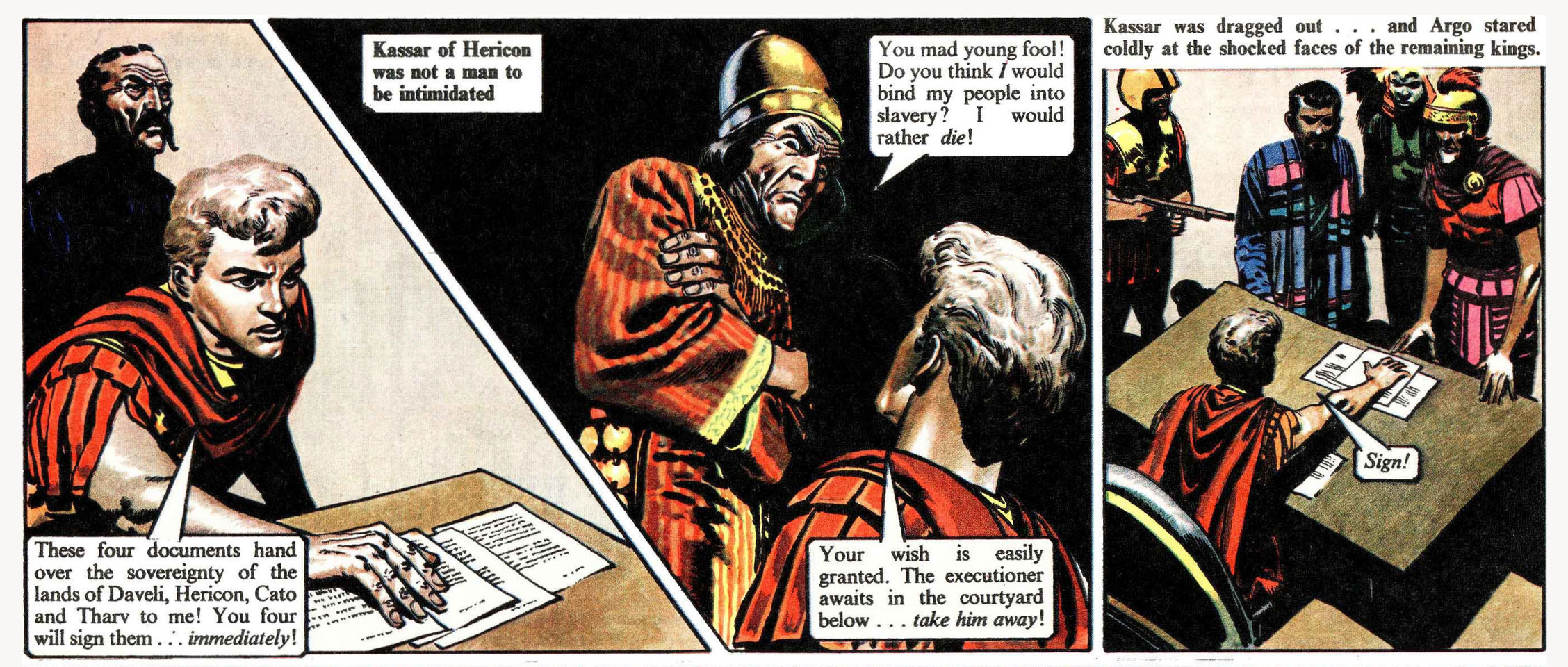
We’ve already mentioned King Kassar of Hericon, whose sister, Ursa, becomes Trigo’s wife. Kassar features prominently in Episode 7 and again in Episodes 10 and 11—and finally in Episode 14, when Trigo’s son Argo has him executed. While he has a stronger claim than Zorth to being a main character, he, too, is non-recurring—for the most final of reasons.
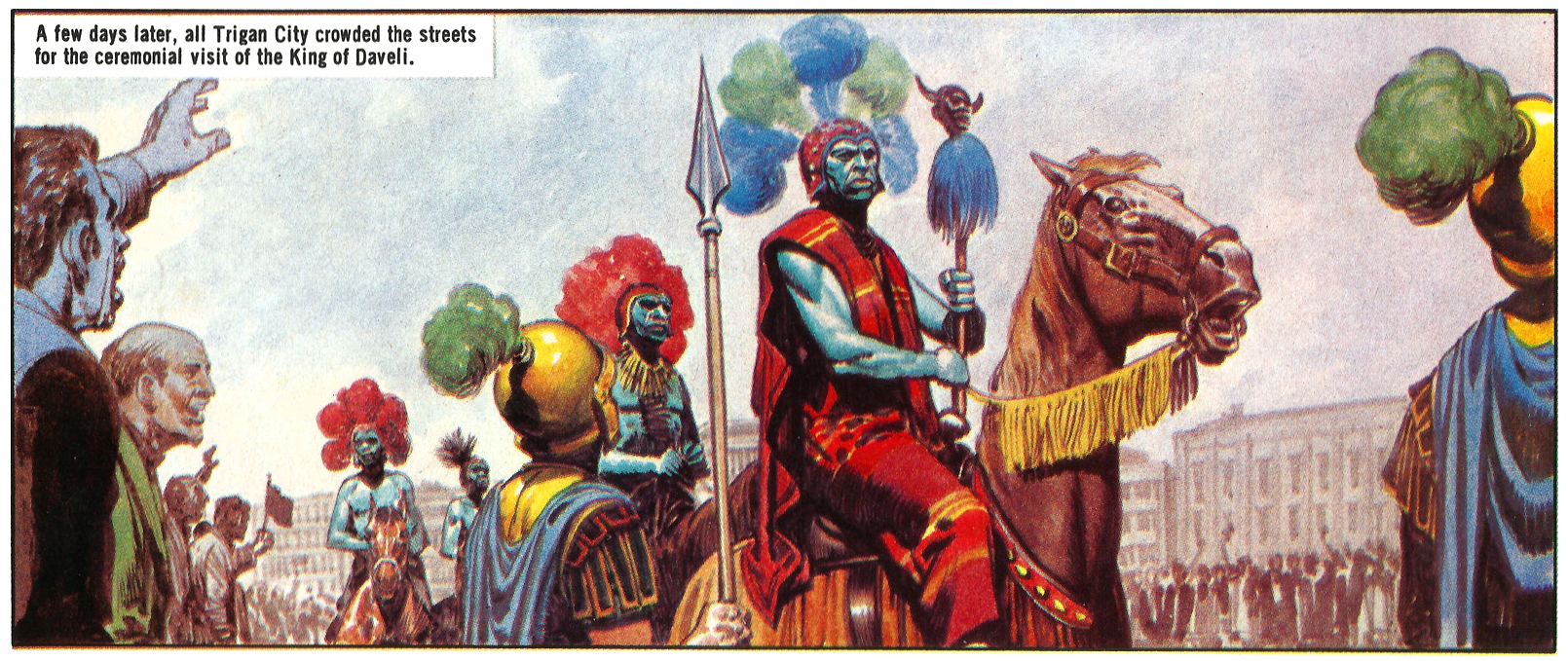
King Imbala of Daveli is the father of Keren, Janno’s oldest and closest friend. He is Trigo’s only dependable ally.
Imbala is a main character in Episodes 2 and 9. Mentioned in Episode 6. He appears in Episode 14 (see above) and, later, in Episode 34.
Three reboots
The foregoing survey of the rise of the Trigan Empire raises a number of questions and highlights some potential pitfalls.
There are questions surrounding the female characters. What happened to Thara? And what happened to Ursa? How and why did Trigo’s wife vanish from the storyline? And—what happened to Nikko? For the remaining nine years of Butterworth’s tenure (Episodes 16 to 69), there’s simply no mention of him at all. Why did Butterworth abandon Trigo’s heir?
The obvious answer is simply that Butterworth had no further use for these characters, so they were never mentioned again. Instead he went on to make the later standalone and (mostly) shorter tales even better than the earlier longer ones. (That’s just my opinion, of course.)
Furthermore, Butterworth could get away with abandoning these characters, by dint of the Fleeting Demographic Rule (or its corollary).
A gimmick or storyline may be reused freely and safely after a few years of dormancy.
. . .
For example, during the Silver Age of comics, the writers assumed that their demographic was young boys ages 9-11 — which would make a three-year turnover safe — and that their demographic rarely read comics frequently enough to notice the repetition. They also believed that even if they did read them often, they wouldn’t notice.
Mike Butterworth had some favourite gimmicks and storylines which he used over and over again. By and large, readers wouldn’t notice the repetitions, nor would they notice the non-recurrences.
All very well. But in 1973 a reprint of the first three stories came along—The Look and Learn Book of the Trigan Empire. It seems that Mike Butterworth was given a new editorial brief—to reprise the early years of the Trigan Empire.
Episode 45, The Great Flood, was the disappointing result. My review of this episode is The not-so-Great Flood [forthcoming]. I rate it 2½ stars out of 5.
Fortunately, in the next episode Butterworth immediately picked up where he’d left off before the reboot and made the Trigan Empire great again.
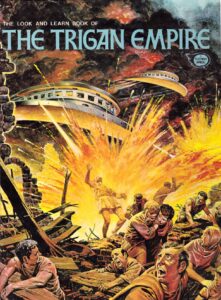
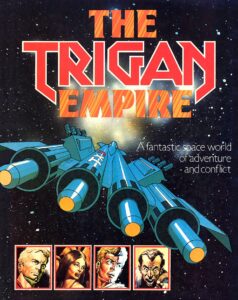
And then in 1978, Hamlyn released The Trigan Empire, reprinting 8 of the first 14 episodes that constitute the rise of the Trigan Empire. Notably, this selection of early tales did not include Episode 14, The Three Princes.
This triggered a second reboot of the rise of the Trigan Empire. By this time, Ken Roscoe had taken over as writer of the series. Presumably, he too was given a new editorial brief—to reprise the early years of the Trigan Empire. And so he did. Roscoe’s later episodes (Episodes 76 through Episode 86) are markedly different from his earlier ones (Episodes 70 through Episodes 75).
My review of the Roscoe era is The Roscoe corpus [forthcoming]. Overall, it’s not favourable. Here I will just mention some of his continuity blunders in the later episodes.
Episode 76, The Flowers of Forgetfulness, stars Salvia in the lead role—a welcome reappearance. But the same episode also reprises King Zorth who, we learned in Episode 45, had long since passed on.
Episode 78, A Tragic Misunderstanding, is one of Roscoe’s better tales. It features the reappearance of Ursa, Trigo’s wife—all good. But it also reprises Ursa’s brother, King Kassar. Clearly, Roscoe was unaware (or didn’t care) that one of Ursa’s sons, Argo, had had her brother Kassar executed in Episode 14!
With 2 out of 3 kings brought back from the dead, it’s ironic that in Episode 77 Roscoe has the one remaining living king, Imbala, killed in the Rebellion in Daveli.
Fast forward to today, and Rebellion Publishing is on track to have reprinted all the tales of the Trigan Empire by the end of the current year.
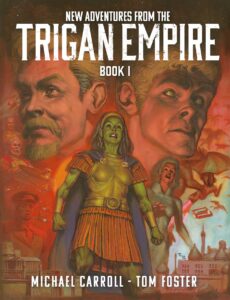
And they’ve commissioned a third reboot. New Adventures from the Trigan Empire Book 1 by author Michael Carroll and artist Tom Foster.
This time it’s going to be good! (And it’s not too late to pre-order yourself a copy of the limited signed & numbered edition.)
Three parallels
To wrap things up, here are three of the many parallels between the Trigan Empire and ancient Rome.
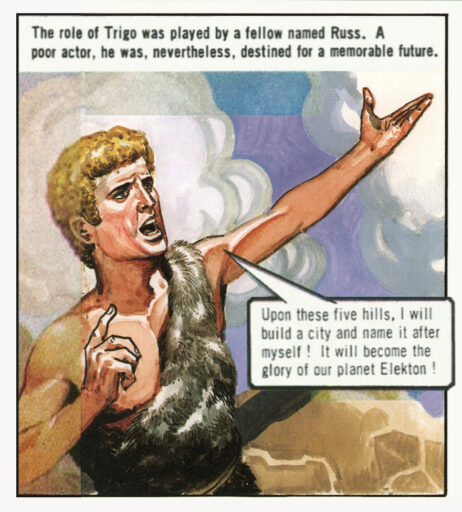
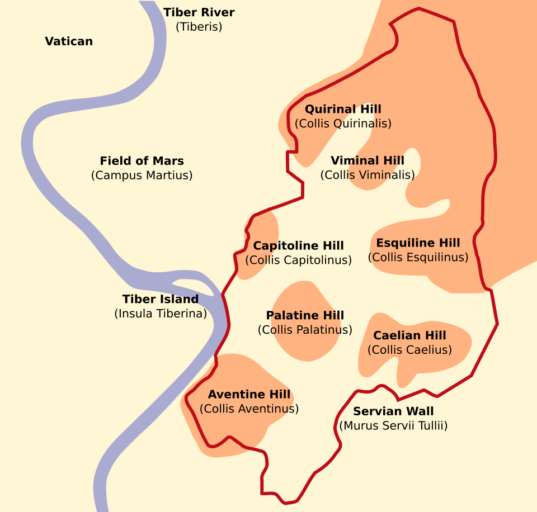
The first parallel. The city of Rome was built on seven hills by the river Tiber. And Trigan City was built on five hills by the river Pyx.
The second parallel. Infant exposure was a cruel, but widespread and socially accepted practice in early ancient Rome. Unwanted newborns were abandoned in public places, often to die or be taken as slaves. The male head of the household had absolute legal authority over his extended family, including his wife, children, and slaves. He had the final say on whether his offspring lived or died or were sold into slavery.
“And so,” writes Butterworth in Episode 14, “the emperor of the Trigans had to make a heart-rending decision . . . for the sake of his people . . .”
It’s one of the most barbaric incidents in the annals of the Trigan Empire. I’m a bit surprised that Butterworth got away with it. And not a bit surprised that when Hawk reprinted Episode 14 as A Tale of Sons and Heirs in the 1989 compilation Tales from the Trigan Empire they chose to leave out the start of the tale entirely.
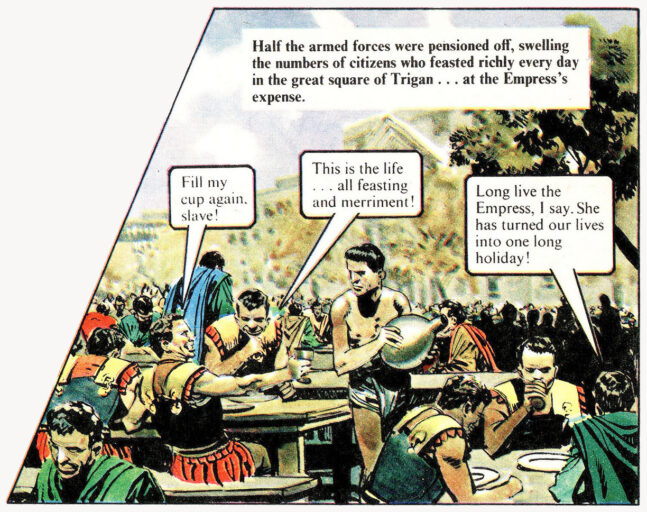
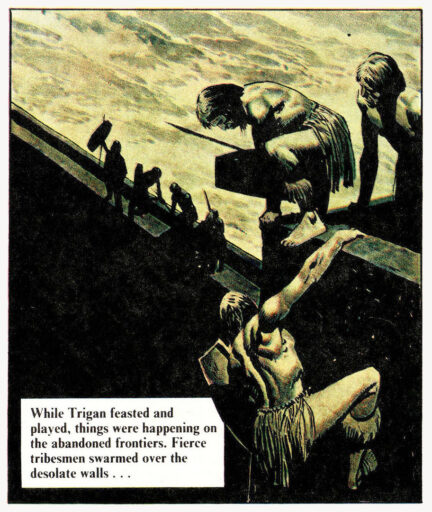
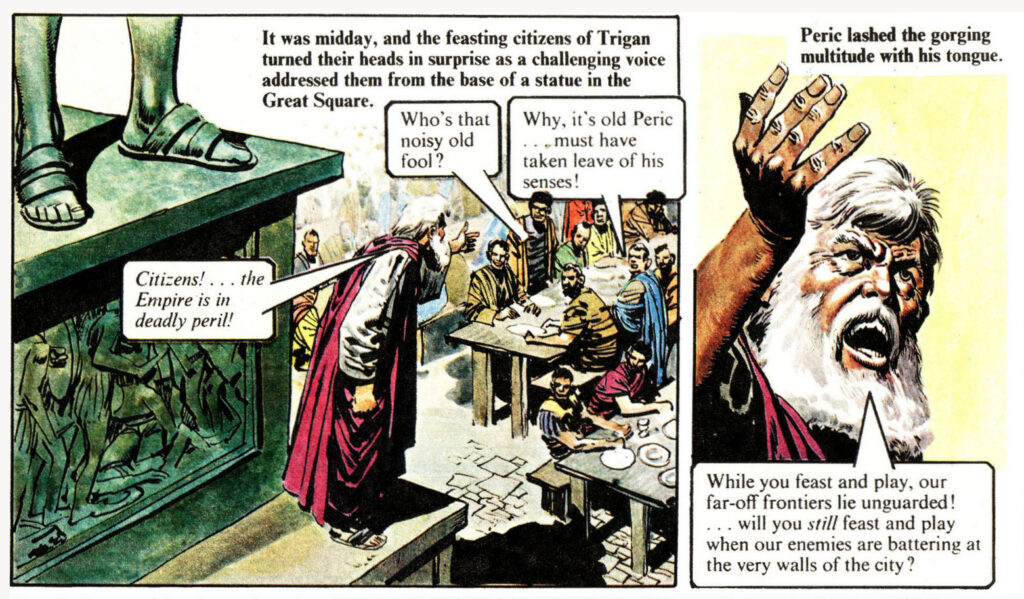
The third parallel. According to Edward Gibbon in The History of the Decline and Fall of the Roman Empire, the Roman Empire succumbed to barbarian invasions largely due to the internal decay, degeneracy, and loss of civic virtue among its citizens. Gibbon argued that the Roman population had become weak, effeminate, and unwilling to maintain the military lifestyle of their ancestors, leading them to abandon the duty of defending their empire.
Gibbon’s thesis plays out in these panels from Episode 12, The Reign of Thara.